

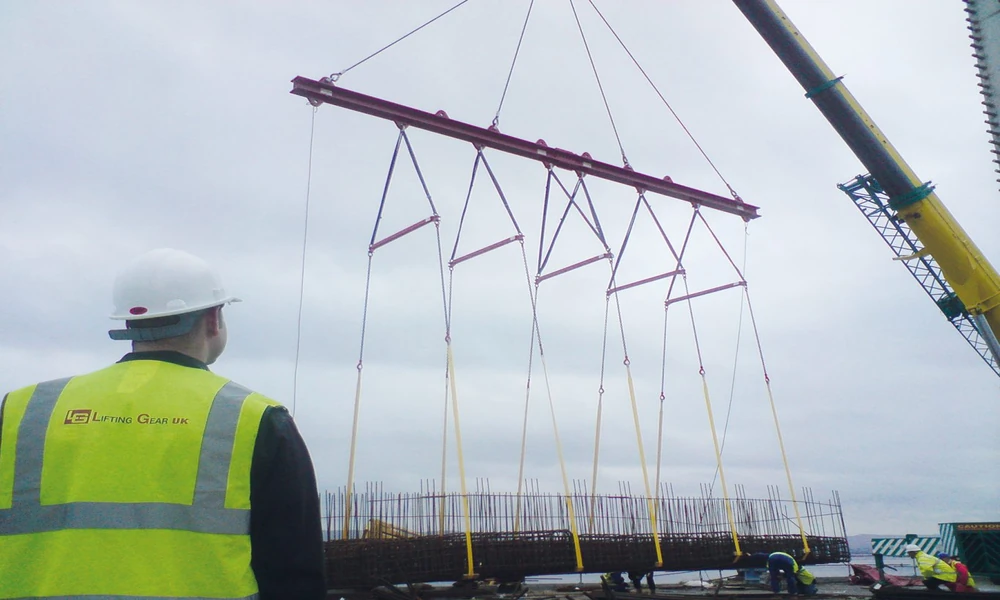
Lifting big or awkward goods necessitates more than just selecting equipment with sufficient capacity. Stability and safety may be significantly impacted by how a load is sustained. Certain loads may tilt or swing due to their size, shape, weight distribution, or elasticity, making them unsafe to handle from a single lifting point. In these circumstances, having several lifting points helps improve control and more equally distribute the burden.
Before deciding how many lifting points are needed, it is important to assess the load’s dimensions, weight distribution, centre of gravity, and structural strength. A proper assessment can help determine whether a single connection can provide adequate stability or whether additional support is necessary to control movement during lifting. Understanding Loads Require Multiple Lifting Points can therefore help workers plan lifting operations more effectively and select suitable rigging arrangements for safer material handling.
2. LONG AND FLEXIBLE LOADS
Large panels, pipelines, steel beams, and structural frames are examples of long items that often require multiple lifting points. These loads may bend, spin, or become challenging to manage if they are lifted from a single point. Maintaining a better-balanced stance when moving is facilitated by providing them with many sources of support.
3. WIDE OR OVERSIZED LOADS
When hanging from a single point, large loads may become unstable. The weight of large equipment housings, manufactured buildings, tanks, and industrial platforms may be dispersed across a large area. Several lifting points can lessen undesired movement and assist in maintaining the load level. Because unequal support might put undue stress on some parts of the load, it’s critical to arrange the lifting points correctly.
4. LOADS WITH UNEVEN WEIGHT DISTRIBUTION
The centre of gravity of certain things is not in line with the geometric centre. One side of a machine that has motors, engines, transformers, or other heavy parts may be noticeably heavier than the other. Such a mass might tilt abruptly due to a single lifting point. Better balance and control when lifting may be achieved by placing many points in accordance with the real centre of gravity.
5. FRAGILE OR EASILY DAMAGED LOADS
Loads that may bend, break, or deform due to their own weight may benefit from several lifting points as well. Careful support is required for large glass frames, completed panels, some manufactured parts, and sensitive machinery. Concentrated tension can be decreased by distributing the lifting power across appropriate locations. But the load itself needs to be robust enough to endure the pressures generated during lifting at each connection point.
6. LONG LOADS WITH OVERHANGING SECTIONS
Lifting objects with substantial overhangs might result in unpredictable behaviour. If its ends are not sufficiently supported, a long pipe, beam, or similar object may swing or spin. Having several lifting points can help with alignment and stability. Depending on the protocol and circumstances at work, tag lines or other relevant control techniques may also be taken into consideration.
7. CONCLUSION
Long, broad, flexible, unevenly weighted, delicate, or oddly formed loads benefit greatly from several lifting points. When chosen and positioned properly, they can lessen uncontrollable movement and enhance balance. In the end, safe lifting relies on careful evaluation of the load’s features, competent staff, appropriate equipment, and appropriate preparation. Material handling can be more regulated, and preventable lifting hazards can be decreased by taking these issues seriously.
