

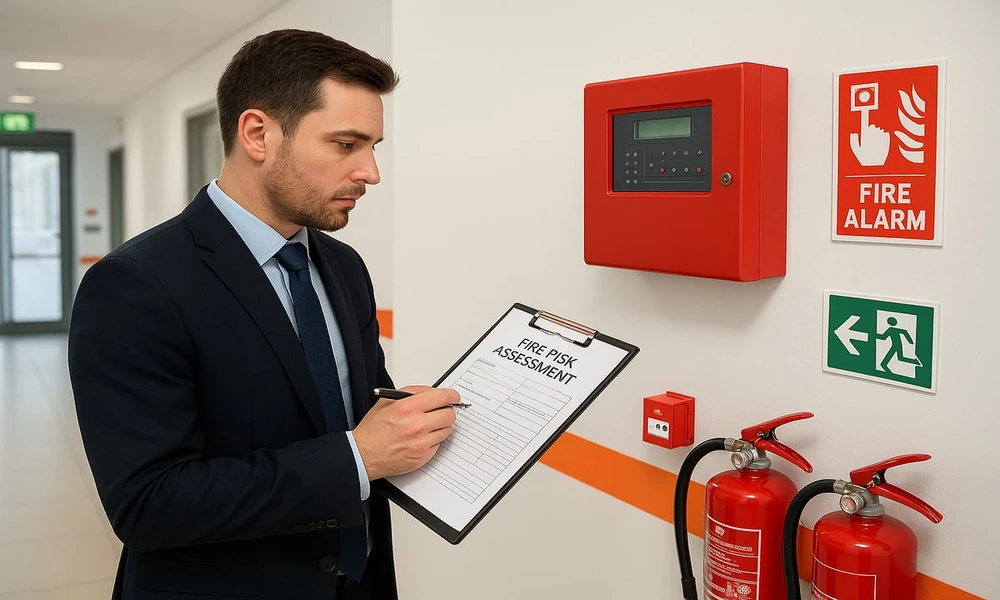
Every business that employs staff, welcomes the public, or occupies commercial premises in England and Wales has a legal duty under the Regulatory Reform (Fire Safety) Order 2005 to carry out a fire risk assessment. Many owners hand this task to an outside specialist rather than tackle it alone, and that single decision can shape how safe a building really is. Pick the wrong person, and you end up with a document that sits in a drawer, ticks a box, and protects nobody. Pick the right one and you get a clear, working plan that keeps staff and customers safe and keeps your insurer happy too.
Why the Right Assessor Matters More Than You Think
A fire risk assessment is not paperwork for its own sake. It is a detailed inspection of how fire could start in your building, how it could spread, and how people would escape if it did. A competent assessor walks every floor, checks every fire door, tests your understanding of escape routes, and questions your staff about what they would actually do in an emergency. A poor one glances round for twenty minutes and hands you a generic template with your company name typed into the header. The gap between those two outcomes is often the gap between a safe workplace and a preventable tragedy.
Check Their Qualifications First
Start by asking what training the assessor holds. Look for a recognised qualification such as the NEBOSH Fire Safety and Risk Management Certificate, or membership of a body that sets clear competency standards for fire risk assessors, such as the Institution of Fire Engineers or the Institute of Fire Safety Managers. Anyone can call themselves a fire risk assessor in the UK, since the title is not legally protected. That makes it your job to check credentials rather than assume them. Ask to see certificates. A genuine professional will hand them over without hesitation.
Ask How Much Practical Experience They Have
Qualifications tell you someone passed an exam. Experience tells you they can apply that knowledge to a real building with real people in it. Ask how many assessments they carry out each year and whether they have worked on premises similar to yours. A warehouse, a care home, a restaurant kitchen, and an office block each carry different fire risks, and an assessor who mainly works on one type of building may miss something specific to another. Ask for two or three examples of past projects in your sector and, where possible, speak to a previous client.
Read a Sample Report Before You Commit
A sample report tells you more about an assessor than any conversation ever will. Look for clear structure, plain language, and specific findings tied to specific locations in the building, not vague statements that could apply to any property in the country. Good reports rank each finding by priority, give a realistic timescale for action, and explain in plain terms why each recommendation matters. If a sample report reads like it was written for a lawyer rather than a business owner, ask yourself whether you will actually understand it, let alone act on it.
Confirm What the Price Actually Covers
Fire risk assessment costs vary widely, and the cheapest quote is rarely the best value. Ask exactly what is included: a full site visit, a written report, a follow-up call to talk through findings, and support with an action plan should all be standard. Some assessors charge extra for revisits or for advice on interpreting the report, so get this in writing before you sign anything. A fair price reflects the time needed to inspect your building properly, not the time needed to produce a template with a few details changed.
Ask About Insurance and Liability
A competent assessor carries professional indemnity insurance, and a good one will tell you the level of cover without being asked twice. This protects you if their assessment later proves negligent and something goes wrong as a result. If an assessor cannot answer a direct question about their insurance, treat that as a warning sign rather than an oversight.
Look at How They Communicate
Fire safety only works if people understand it. During your first conversation, notice whether the assessor explains things clearly or buries you in jargon. Do they ask questions about how your building is actually used, or do they quote a fee and move on? The assessment itself is only half the job. The other half is making sure you, your managers, and your staff understand what needs to change and why.
Check Availability for Reviews, Not Just the First Visit
A fire risk assessment is not a one-off event. It needs reviewing whenever your building changes, whenever your use of it changes, and at least once every twelve months as good practice. Ask whether the assessor offers ongoing review services and how quickly they can respond if something urgent comes up, such as a fire door failing an inspection or a new tenant moving into a shared building. An assessor who disappears after the first visit leaves you without support exactly when you might need it most.
Trust Your Own Judgement Too
After checking qualifications, experience, sample reports, and pricing, trust your reaction to the person in front of you. Did they ask thoughtful questions about your building? Did they take time to understand how your business actually runs, or did they rush through a standard checklist? Fire safety depends on someone who takes your specific risks seriously, not someone working through a script. The right assessor treats your building as unique, because it is.
Choosing well protects more than your legal position. It protects the people who walk through your doors every day.
