

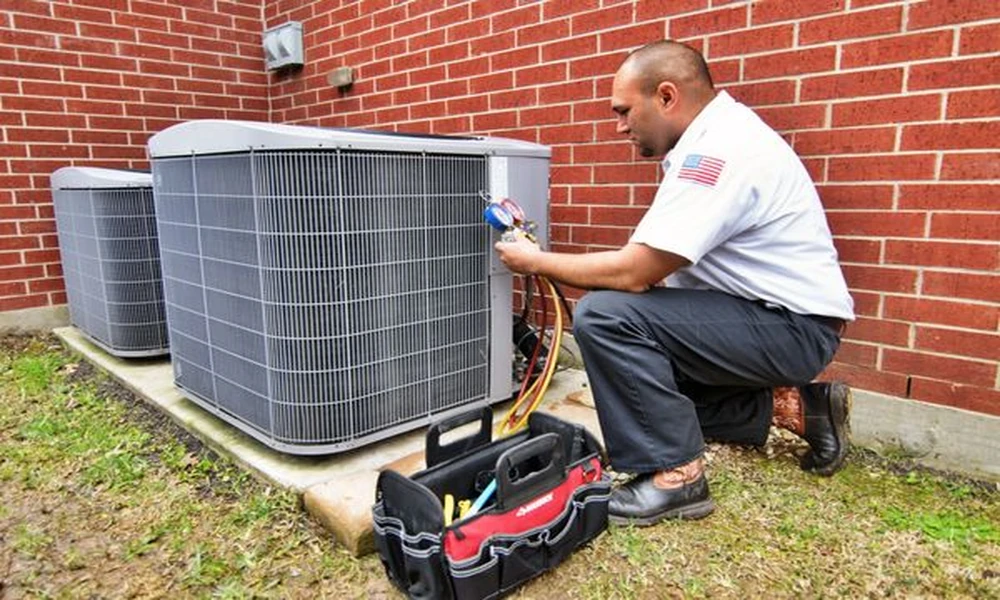
In Brevard County an air conditioner runs close to ten months a year, and the two months it rests are rarely restful. A January cold front can push a heat pump into auxiliary heat for the first time all year. By May the outdoor dew point sits in the 70s, and the system is no longer just cooling air. It is pulling water out of the house all day long.
That shifting workload is why a single fixed tune-up date works poorly here. The local calendar is shaped by humidity, pollen, lovebug flights, afternoon storms and hurricane threats, and each one stresses a different part of the system. Matching service to those shifts catches small faults while schedules are open and parts are easy to find.
The months that matter most are the ones before the heavy load arrives. Coils cleaned in March meet a July heat index of 105°F in good shape. A drain line flushed in April is far less likely to back up during the first week of storms. Most peak-summer breakdowns trace back to something that was visible weeks earlier.
Homeowners who would rather keep that schedule than react to a failure often turn to Air Conditioning Services in Palm Bay from Launchpad Services, a locally owned contractor licensed in Florida (CAC1822716) that covers Palm Bay and the rest of Brevard County. Its Comfort Club membership pairs seasonal maintenance visits with priority scheduling and a discount on repairs, and the team will look over a replacement quote from another company free of charge before anyone commits to new equipment. Booking a spring visit ahead of the summer rush is the easiest place to begin.
January and February: Heat Pumps Face Their One Real Test
Most Palm Bay homes heat with a heat pump rather than a furnace. When overnight lows drop into the 40s, the system leans on electric heat strips to keep up. A faint burning smell for a few minutes on the first cold morning is usually dust burning off those strips. A smell that lingers, or a breaker that trips, points to a wiring or strip problem.
Heat strips cost far more to run than the heat pump itself. If the thermostat shows auxiliary heat running on a 60°F day, the settings or the heat pump need attention. The outdoor unit may also steam and go silent for a minute or two. That is the defrost cycle, and it is normal.
March and April: The Window That Sets Up the Whole Year
These are the dry months, and oak pollen settles on everything, including outdoor coils and return filters. Filters may need changing every few weeks during heavy pollen. This is also the best time for a full cooling inspection: coil cleaning, a refrigerant charge check, electrical connections and a capacitor test. Capacitors weaken over winter and tend to fail on the first hot week.
Spring is also the calmest time to plan a replacement. Systems near the coast often wear out sooner than national averages suggest, so a unit past 12 years deserves a frank conversation. New equipment now ships with lower-impact refrigerants such as R-454B or R-32, and older R-410A systems are becoming more expensive to service as supply tightens.
May Through September: Water Becomes the Main Job
The rainy season usually arrives in late May, and from then on dehumidification matters as much as temperature. The EPA’s guidance on controlling moisture at home recommends keeping indoor relative humidity below 60 percent, ideally between 30 and 50. An oversized system that cools fast and shuts off never runs long enough to reach that range, which leaves rooms cool but clammy.
All that removed water has to drain away. Algae grows quickly in condensate lines during warm months, and a clog can trip the float switch or overflow into a ceiling. Pouring a cup of white vinegar into the drain access every month or so keeps it clear.
Setpoints matter too. The Department of Energy suggests setting the thermostat to 78°F when people are home and awake during summer, with higher settings while away. Lovebug flights in May and again in September can also coat condenser fins, so a gentle rinse with a garden hose helps airflow.
June Through November: Planning Around Storm Season
The Atlantic hurricane season runs from June 1 to November 30, overlapping the hottest stretch of the year. Before a storm, shut the system off at the breaker and confirm the outdoor unit’s tie-down straps are tight. Florida’s building code expects condensers in high-wind areas to be anchored, and loose brackets are easy to miss.
After a storm, wait before restarting. If floodwater reached the outdoor unit, it needs inspection first. Power surges during outages damage control boards and compressors, so a whole-unit surge protector is a reasonable add. Beachside homes in Indialantic or Satellite Beach also face salt spray that corrodes coil fins faster than inland heat ever does.
| Months | What the weather brings | Part under most stress | Homeowner check | Technician visit |
|---|---|---|---|---|
| Jan to Feb | Cold fronts, lows in the 40s | Heat strips, defrost controls | Watch for aux heat on mild days | Heating check if strips misbehave |
| Mar to Apr | Dry air, heavy pollen | Coils, filters, capacitors | Change filters every few weeks | Full cooling inspection |
| May to Sep | Rain, dew points in the 70s | Drain lines, humidity control | Vinegar flush, hose rinse of fins | Midsummer check if humidity stays high |
| Jun to Nov | Tropical storms, surges | Electrical parts, mounts | Breaker off before storms | Post-storm inspection |
| Oct to Dec | Cooler, drier air | Ducts, attic insulation | Note rooms that never cooled well | Duct sealing or air quality work |
October Through December: Repairing What Summer Exposed
The fall months reveal what the system struggled with. A bedroom that never got cool, or a vent that barely moved air, often points to leaking ducts or thin attic insulation. Summer attics can climb well past 130°F, so duct sealing and insulation work is far more comfortable for crews once temperatures drop.
This is also a sensible time for indoor air quality upgrades like better filtration or UV lights in the air handler, which help limit mold growth on the coil. Once the house is sealed back up for winter, every improvement made in these cooler months carries straight into next spring’s cooling season.
